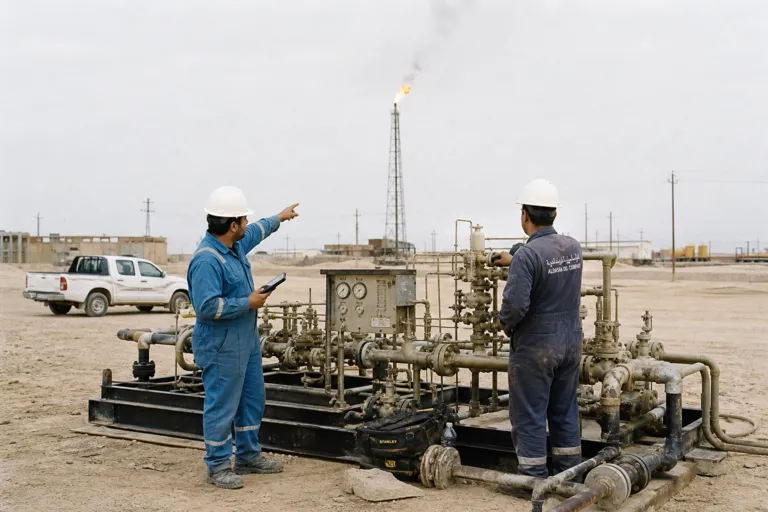
Iraq is at an energy crossroads where waste and scarcity exist side by side. S&P Global reports the country consistently ranks among the top three global gas flarers and burns about 17–18 billion cubic meters (bcm) of associated natural gas annually. That volume is described as roughly equivalent to Iraq’s entire domestic gas consumption and more than double its actual gas imports from Iran. Shafaq News, citing the World Bank’s 2024 Global Gas Flaring Tracker, puts 2024 flaring at about 17.37 bcm. The scale of burning underscores why capturing flare gas is framed as both an economic and environmental opportunity.
In 2025, Baghdad tied flare capture to power security and broader energy resilience. Oil Minister and Deputy Prime Minister for Energy Affairs Hayan Abdul Ghani said associated-gas utilization has climbed above 70%, presenting it as central to Iraq’s energy transition and fiscal stability. But multiple sources also stress the missing midstream link: processing plants, compression, and pipelines, plus fragmented governance that slowed investment cycles. S&P Global adds that legacy service contracts often fail to incentivize gas capture, pointing to the need for clearer commercial and legal drivers and improved governance to attract international partnerships and expertise.
Where the Big Volumes Are: Basra’s Integrated Hubs
The most visible lever is the $27-billion Gas Growth Integrated Project (GGIP) anchored in Basra. Argus Media describes GGIP as a multi-pronged development led by TotalEnergies, launched in 2023 after delays, and watched as a test of Iraq’s ability to turn pledges into performance. The core is redeveloping the Ratawi oil field and making it flare-free through the ArtawiGas25 gas capture hub. Argus says ArtawiGas25 will eventually reach 600mn ft³/d (6bn m³/yr), with a 300mn ft³/d first phase expected on line early next year and a first 50mn ft³/d unit due to start up before the end of this year. Shafaq News separately reports the partners reiterated plans to recover up to 600 mmscfd of gas.
Other Basra-linked capacity adds another layer to the story. Shafaq News reports that in July the minister inaugurated new processing capacity in Basra, including a central processing facility and a fresh line at the Basra Natural Gas Liquefaction plant, expanding aggregate capacity by an estimated 330 mmscfd. Argus highlights Basrah Gas (BGC)—a joint venture of Iraq’s South Gas, Shell, and Mitsubishi—whose flare-reduction infrastructure lifted processing capacity to 1.4bn ft³/d after it raised $360mn in 2021. Argus also reports BGC is seeking a $500mn loan from the IFC to expand the facility further, showing how financing is being layered onto existing assets rather than relying on a single megaproject.
The payoff is increasingly described in explicit commercial terms, and the timelines are sharpening. CNBC reports Iraq’s Prime Minister said Baghdad has signed deals with foreign investors to capture gas now flared that is worth $4 billion to $5 billion a year, and argued recovering and processing it could ease chronic power shortages. On targets, Shafaq News reports Abdul Ghani has linked the current project pipeline to ending flaring by 2028–2029, while another Shafaq News report states Iraq is moving to end gas flaring by 2029. Together, these details define the core of Iraq gas flaring reduction: large integrated hubs, incremental capacity additions, and investment structures meant to turn routine burning into fuel, revenue, and reliability.
How much gas does Iraq flare each year, according to the sources?
What is GGIP, and what gas-capture capacity is planned at Ratawi?
What progress has Iraq reported on associated-gas utilization?
What does Iraq say is the value of capturing gas that is currently flared?
What does the Iraq gas flaring reduction timeline look like in official statements?